Showing posts with label מצוות מעקה. Show all posts

Sunday, 6 October 2013

Beyond Maakeh and Lo Tasim Damim

Well, now that we've looked at the scope of Maakeh and Lo Tasim Damim, let's look beyond them. Even where these mitzvot don't apply, others may.


Rambam


The Rambam brings another, broader mizvat aseh into the picture in after introducing Maakeh(רוצח יא:ד)

וכן כל מכשול שיש בו סכנת נפשות--מצות עשה להסירו ולהישמר ממנו ולהיזהר בדבר יפה יפה, שנאמר "הישמר לך ושמור נפשך" (דברים ד,ט). ואם לא הסיר, והניח המכשולות המביאין לידי סכנה--ביטל מצות עשה, ועבר על "לא תשים דמים" (דברים כב,ח).

The pasuk is a curious one to bring, since it sounds more like a warning to keep the mitzvot, than a mitzva to remove hazards:

רק הישמר לך ושמור נפשך מאוד, פן-תשכח את-הדברים אשר-ראו עיניך ופן-יסורו מלבבך, כול, ימי חייך; והודעתם לבניך, ולבני בניך

The source of this drasha is unclear and it appears to be of the Rambam's own invention. The pasuk implies that protecting oneself is a good thing, so even if we don't have a formal mitzva to do so, the Rambam regards this statement of value as halachically binding.

Ramban


The Ramban on the Torah(דברים כב:ח) brings a different, less novel pasuk(ויקרא יט:טז)

לא תלך רכיל בעמיך לא תעמד על דם רעך אני יהוה

The Sefer Hachinuch counts this as an independent mitzva and describes it as an obligation to save the life of our fellow Jew who is in mortal danger.

This seems like an obvious choice, so why didn't the Rambam bring this pasuk? Perhaps because it is a לא תעשה so it only extends Lo Tasim Damin, not Maakeh.


Why do we need Maakeh and Lo Tasim Damim


So in addition to Maakeh and Lo Tasim Damim, we have even broader obligations to remove hazards from one or both of these additional sources. So why did the Torah need to command us in mitzvat Maakeh and Lo Tasim Damim at all?

One answer that I've heard(I think from Rav Michael Edrei) is that the torah wants us to be more careful in our own home. Normally, we wouldn't be obligated to put up a guard-rail on the roof, since the roof is a place people rarely go, and when they do, they know to be careful. Nevertheless, the Torah gave a higher standard for the home.

Another answer is that these general mitzvot only cover mortal danger, while Lo Tasim Damim also coveres injury.

Another answer is that לא תעמד על דם רעך is only concerned with others, while Maakeh and Lo Tasim Damim also are concerned with your safety.

Saturday, 5 October 2013

Maakeh & Lo Tasim Damim: Fixed Structures

Another question that arises when discussing the scope of mitzvot Maakeh and Lo Tasim Damim is whether they just apply to fixed structures, or to all hazards in general. The question arises because the pasuk and the examples given in the sifrei all seem to focus on structures like buildings and pits.

Two Possibilities for Maakeh


Rav Moshe Taragin claims there are two shitot, regarding Maakeh, although they agree about Lo Tasim Damim:

Rashi(בבא קמא צא:) implies that both mitzvot apply generally, even to a mobile hazard, like a dangerous animal.

The Yam Shel Shlomo indicates that Maakeh applies to a fixed structure, while Lo Tasim Damim applies more generally, even to mobile hazards.

I have to admit, that looking at the gemara, I not certain that Rashi is even talking about Maakeh. The source seems pretty ambiguous to me, but it is certainly possible that I'm missing some detail that Rav Taragin doesn't mention explicitly.


Back to the Question of Connection


Regarding the Yam Shel Shlomo's opinion, our take on the Netziv seems to apply: namely that in the pasuk, Maakeh is stated as a specific mitzva, while Lo Tasim Damim sounds more general, and therefore they have different scopes.

Similarly, Rav Taragin's understanding of Rashi is like the Ramban, who thinks the scope of the mitzvot are connected. The only difference is that, while the Ramban contracted the scope of Lo Tasim Damim, Rashi expands the scope of Maakeh.

Wednesday, 2 October 2013

Maakeh and Lo Tasim Damim: Severity of Hazards

So, previously we established that there is a debate whether mitzvas of Maakeh and Lo Tasim Damim are or are not essentially linked, with the consequence to what degree they cover the same cases. Now we'll take a look at a related question: what cases do these mitzvot actually cover?

The basic case is that brought in the pasuk itself, that of a house with an accessible roof, where the  obligation is to add a guard rail. Once we move beyond that case, then the questions begin. We'll start with the question of severity and then cover other questions in future posts...

Death or Injury


So are these mitzvot concerned with hazards that can cause any injury or just lethal hazards?


Most rishonim understand the gemara(בבא קמא נ:, נא.) and it's 10 tefach limit as implying that these mitzvot are only concerned with hazards which might cause death.  As the Meiri says there(ד"ה בית)

יראה מכאן שאין מצות מעקה לחשש נזקים אלא לחשש מוות

On the other hand, there is the baraita of Rebbi Natan, brought several places in the gemara(בבא קמא טו:,בבא קמא מו.,כתובות מא:), and used in discussing cases of potential injury, not death:

רבי נתן אומר מניין שלא יגדל אדם כלב רע בתוך ביתו ואל יעמיד סולם רעוע בתוך ביתו ת"ל לא תשים דמים בביתך

The Sefer Hachinuch(תקס"ז) takes these gemaras at face value and includes nezikin under the mitzva of לא תשים דמים, although he still says that מעקה is only concerned with lethal hazards(תקלח).

Rav Soloveichik, on the other hand, explains these gemaras according to the other shita, saying that chachamim made a gezeira extending the issur to include nezikin.


Secondary Sources


Rav Moshe Taragin's Shiur on Lo Tasim Damim


Rav Reuven Taragin's Shiur on Lo Tasim Damim in Bava Kama

Sunday, 29 September 2013

The Connection Between Maakeh and Lo Tasim Damim


So, as I implied in my previous post, I've started working the sugiot of Maakeh and Lo Tasim Damim. Interestingly enough, these two mitzvot are learned out from the same pasuk(דברים כב:ח)


כִּי תִבְנֶה בַּיִת חָדָשׁ וְעָשִׂיתָ מַעֲקֶה לְגַגֶּךָ וְלֹא תָשִׂים דָּמִים בְּבֵיתֶךָ כִּי יִפֹּל הַנֹּפֵל מִמֶּנּוּ.

The Sifrei brings the drasha:

" 'ועשית מעקה לגגך' - מצות עשה. 'לא תשים דמים בביתך' - מצות לא תעשה".

So, taking the psukim at face value, we have:
  • one positive commandment to build a guardrail around one's roof
  • one prohibition to permit hazards in one's home


The Implied Connection


The fact that these mitzvot share a pasuk seems to indicate a connection and the language of the Sifrei also seems to imply that these mitzvot apply together. Also, when reading many of the sources in chazal, it is not entirely clear if a source is talking about one, the other, or both mitzvot. So a key question for understanding this sugia is: What is the connection between these two mizvot, and when one applies, does the other automatically apply.

In fact, when looking at the Rishonim and Achronim, we can find both a variety of approaches. Two extremes among them are the Ramban, who implies that the two are always applied together, and the Netziv who distinguishes sharply between them.

The Ramban


The Ramban(קידושין לד.) believes that Maakeh is the dominant one of the two mitzvot. Lo Tasim Damim is only there to strengthen the severity of Maakeh. As such, Lo Tasim Damim only applies where Maakeh also applies.


ול"נ שעיקר מצותו עשה, שאין לאו שבו אלא לקיים העשה, דכתב רחמנא ועשית מעקה תחילה והדר לא תשים דמים בביתך כלומר לא תעכב מלעשות מצוה זו, ולאו שאין בו מעשה אחר אלא קיום עשה שבו הוא

The Netziv


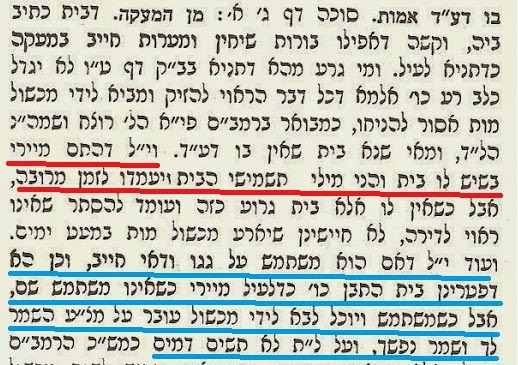
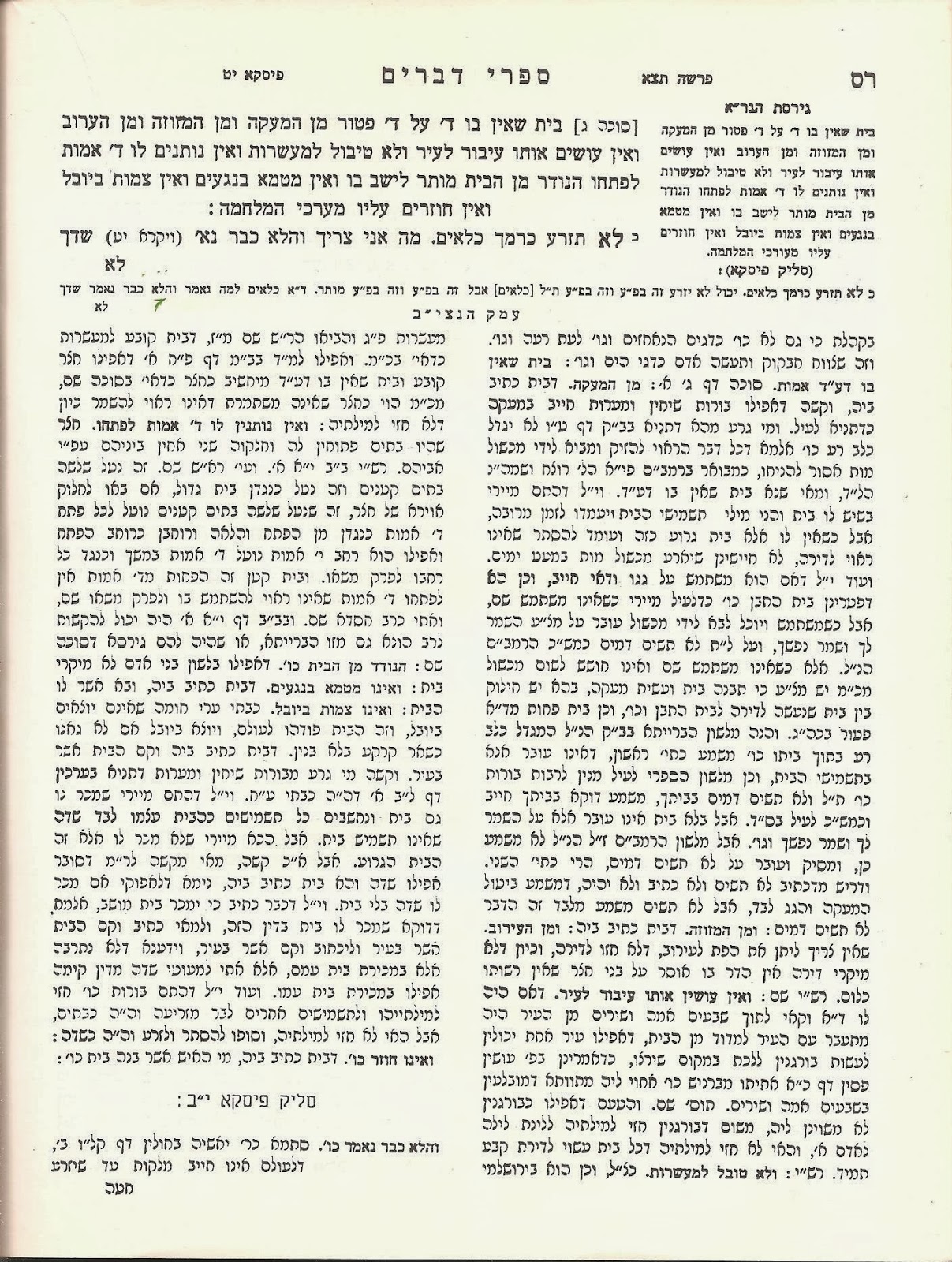
The Netziv(סיפרי עמק הנציב על הפסוק) draws a clear distinction between the two mizvot. Maakeh is the specific mitzva of building a guardrail around dangerous drops in and around your house. Lo Tasim Damim is a more general mitzva of removing dangers.

I've already brought the Netziv in full, but here are some relevant passages to understanding his shita. Red lines pertain to Maakeh, while blue pertain to Lo Tasim Damim.


And finally, it's worth checking out Reuven Taragin's shiur on Lo Tasim Damim, which turned me on to these two mekorot.

Saturday, 28 September 2013

Treasure Hunting for the Netziv


So the last few day's I've been trying to locate the Netziv's perush on the Sifrei, the Emek Hanetziv.  It hasn't been easy. Google Search turned-up next-to nothing.  Online bookstores don't have it.  Most people I asked never heard of it. The two rabbis who I spoke who did know the book were divided as to whether it's just a standard perush included with the Sifrei or whether it's it's own book.

Well, a couple people told me to check out the library in the Central Ashkenazi Shul in Akko. I went to shacharit there(weekday davening is actually held in the library) and spent half the time peeking surreptitiously at the not-terribly-organized shelves.  Then, suddenly I saw it.  Three volumes of moderate width "Sifrei Emek Hanetziv".

It's a pity there's so little online about the book. These days, you can get all the basic Jewish texts online, at least as a scanned PDF, but there are still a lot of books with little or no mention online. I would love to scan the entire book and put it up, but I don't have the time or the equipment, so here at least are the pages I scanned for my own personal use, about Maakeh.